
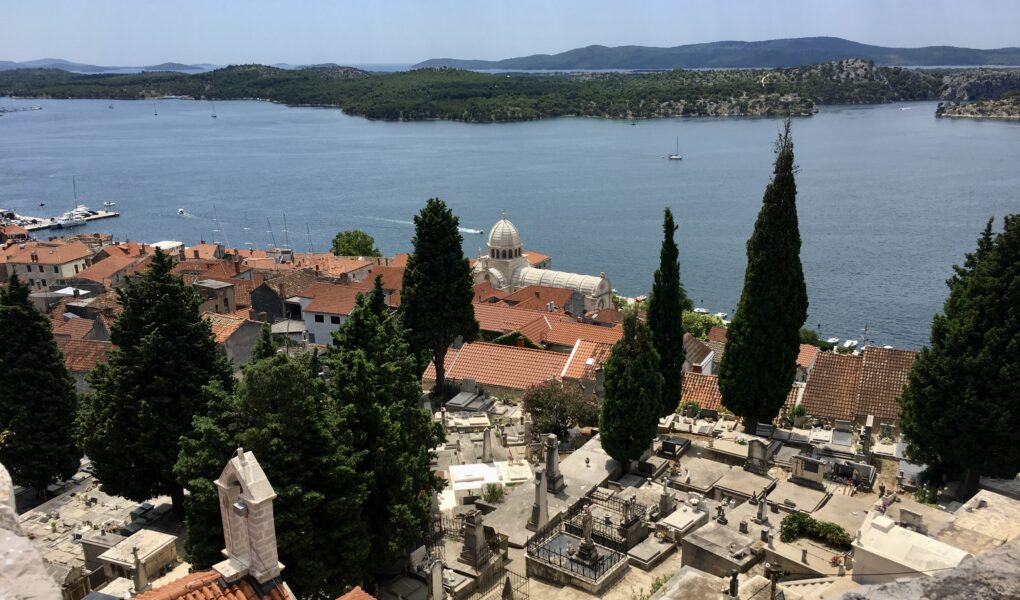
The narrow limestone lanes and historic fortresses of Šibenik, Croatia, are glorious enough in themselves to draw hundreds of thousands of visitors each year. Šibenik is only an hour’s drive from Split, and easily accessible to the sailing crowd. Its small scale and local feel, plus the access it offers to Krka National Park, make it an ideal place to spend a few days. For wine lovers there are ample attractions just outside this small city that are reachable by e-bike or car and easily combined with visits to the area’s natural and cultural sites. Here are 5 Šibenik wine routes, with suggestions for non-wine destinations nearby, and two standout restaurants.
The wineries recommended here are only some of the more prominent wineries in the region. You can find others using this site’s Winery Finder Tool to customize your itinerary. Some of these wineries welcome drop-ins, but it is safest to call ahead and book a tasting. This is especially important if you’re traveling in the shoulder seasons, when tasting rooms reduce their hours.
To browse local wine events, such as a festival celebrating mussels and Debit wine in Šibenik, see our Event Calendar.
And for more tips on visiting Croatian wineries, read this.
Skip to one of the 5 wine routes, or to restaurant recommendations:
1. Northwest/Vodice route
2. North/Plastovo route
3. Northeast/Oklaj route
4. South/Jadrtovac route
5. South/Primošten route
Restaurants for wine lovers
Route 1: North of the Canal
Šibenik is an ancient city founded in a strategic location. The mouth of the Krka River forms a natural bay in front of the city, then carves a narrow canal to join the sea. This creates two broad defensive peninsulas guarding the bay where Šibenik sits, with only a narrow access through the canal—a challenge for pirates and invaders by sea.
Cross the Šibenik bridge north of the city and you are on the rural northern peninsula. Only 15 minutes’ drive from Šibenik is Baraka Winery, where Filip Baraka and team strive to make “honest, elegant wines,” he says, from indigenous grape varieties, including Debit, Pošip and Babić. The winery offers a tour plus different themed tastings for visitors. For hardcore wine lovers, there is a three-hour barrel tasting in the cellar. After your tasting, stroll through some of Baraka’s 400 olive trees to the ruins of a sixth-century basilica on the property.
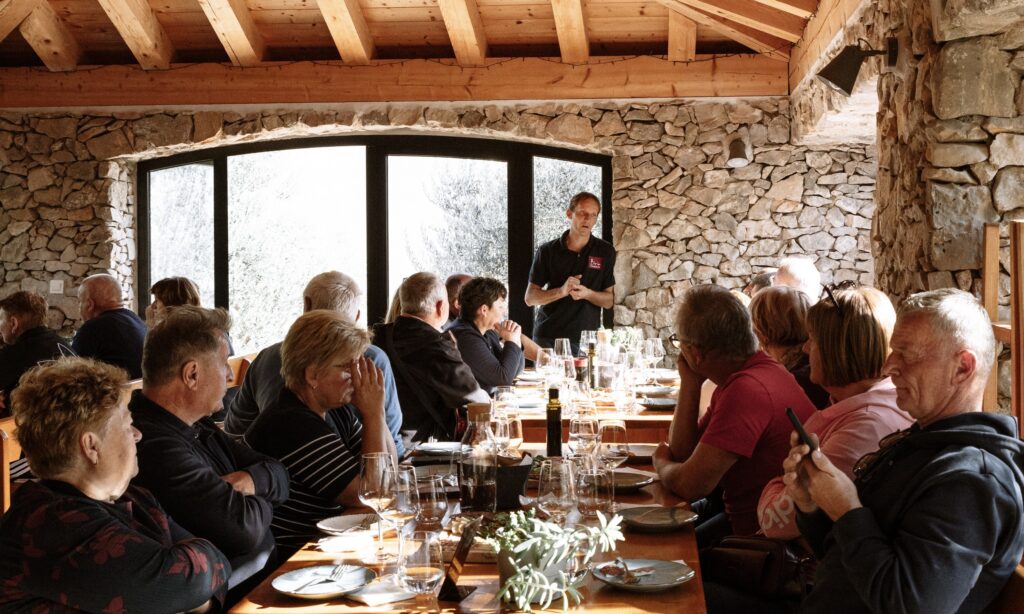
Drive a further 6 minutes to the town of Vodice to visit Vinarija Birin. Here, Nikola Birin has carved out a fun retreat at his family property, which has some of the hip feel of an urban garage winery. Birin hosts a five-wine tasting with hand-selected, local cheeses and meats. Keep an eye on Instagram for announcements of occasional live music gatherings and balote (bocce) challenges.
Balance your half-day trip to wineries north of the canal with a half day exploring the peninsula south of the canal. You can get there easily from Šibenik by car or e-bike, or by bus to Zablaće. You won’t find wineries here, but instead what one local describes as her secret escape. Along the canal Sveti Ante, the southern peninsula is dominated by a park called Naš Mir (Our Peace), filled with trails for hiking or cycling. If you drive, park at the Mandalina parking area or near Pink Lake and pick up the trail that takes you atop the canal, past St. Nicholas’s fortress, beaches, cafes and fantastic sea views. Wear your swimsuit if it’s warm, and jump in where you can. If you can locate the turnoff, you can even walk through a 200-meter World War II military boat tunnel called Hitler’s Eyes. There are maps at the various trailheads.
Route 2: Innovators in Plastovo
If you have reason to take the highway E65 north from Šibenik, you will soon pass a scenic rest stop (“Odmorište Krka”) and then cross a high bridge over the Krka River. Glance down to the right (or better yet, pause at that rest stop) and you will see the village of Skradin nestled in the curve of the river, far below. On the high bank of that river gorge, among rolling hills, is an all-in-one wine destination: the tiny village of Plastovo, only a 30-minute drive (or a scenic bike ride) to the north of Šibenik. Tiny it may be, but the village is home to two wine innovators in particular, at wineries an easy walk of each other.
Bibich Winery is legendary for both its wines and its food. You can book a guided tasting experience or while away an afternoon sitting in the shade of the generous courtyard, sampling wine by the glass along with excellent, innovative bistro dishes favoring local ingredients. The late Alen Bibić was revered for his part in reviving Plastovo’s wine production immediately after the Homeland War of the early 1990s. He did so with unusual foresight and sensitivity to changing international tastes, even while championing local grape varieties. His wines garnered fans all over the world, and his son, Filip, is carrying the legacy forward in his own style. (Pro tip: Small groups can book one of two luxury villas situated in the Bas de Bas vineyard, a 10-minute drive from the winery.)
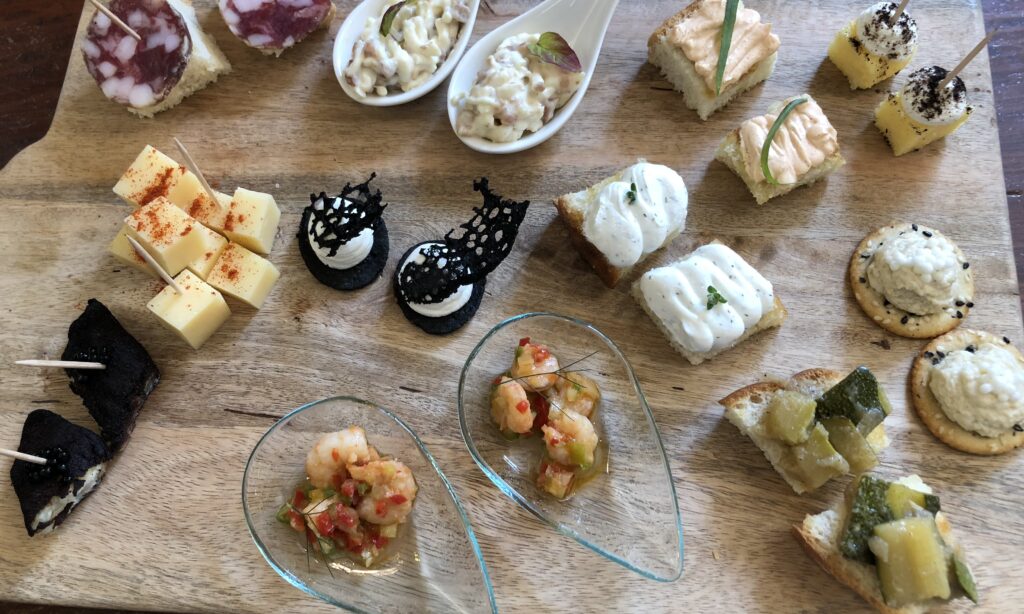

Just around the corner, on the narrow main street of the old village, is the home and winery of Ante Sladić, whose research on grape varieties and wine making in the region informs the decisions he makes in the field and the winery. His distinctive labels also speak to local history, and part of tasting here is learning the significance of each. Settle in the shady garden and steep yourself in wine, oil, local charcuterie and storytelling. Sladić works exclusively with indigenous varieties, such as Maraština, Debit, Lasina and Plavina. His sparkling and sweet wines and rakija (brandy) are all excellent—sample them if you can.
To round out your winery visit, choose from “town” (nearby Skradin) or “country” (the extensive ruins of Bribirska Glavica) according to your interests.
To visit Skradin, make the steep descent into the gorge of the Krka River (10 minutes driving). You can wander the village lanes and settle down with a snack on the pretty beach at the river’s edge. Or visit the quirky Oldtimer Museum. This is not an exhibit of antique people, as one might think, but a fantastic collection of vintage cars. Arrayed on either side of the showroom in east-versus-west fashion are what may be thought of fondly as the tin cans common in Yugoslavia (Lada, Fiat, Zastava, etc.) and the tanks of the West (including a gorgeous Peugeot 504 and an impeccable Karmann Ghia). The curator, Milo, will tell you this last is his favorite, but he clearly reveres all of these oldtimers, and can tell you all you want to know about the cultural history of each. There is a small section of motorcycles as well.
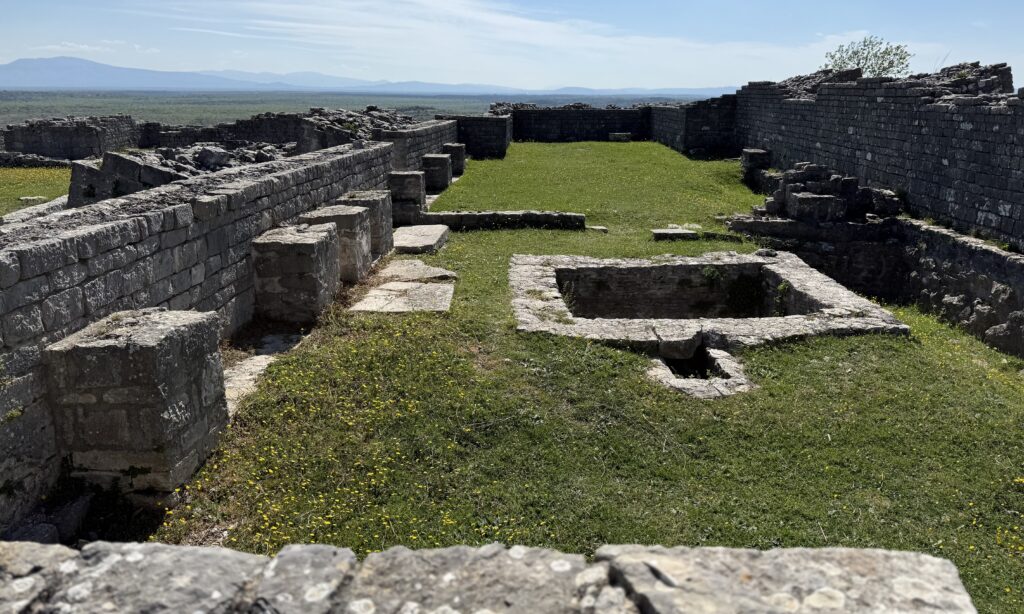
If you prefer countryside and archaeology, drive or pedal northwest from Skradin (14km) or Plastovo (11km) through flat karst plains dotted with sudden steep hills. On top of one of these, in Bribir, is a fascinatingly layered ruin where people of different eras built a nympheum (1st to 2nd century), churches (13th century), a palace (13th century), a defensive tower (16th to 17th century) and more. This important site was the center of the Croatian state in the 13th century and is thought of as the Croatian Troy. In a country with more than its share of historic stones scattered about far-flung fields, Bribirska Glavica will reward even the most jaded seeker of ruins. Wander freely through the historic remains—watch out for cisterns—and enjoy the view over the surrounding plain. (Pro tip: Don’t stop where Google Maps tells you to; continue until you find the gravel drive up to the site and the sign explaining it, where you can park.)
Route 3: The Left Bank (Oklaj)
The Krka River is central to any visit to the Šibenik area. Moving upriver from Šibenik, a chain of aquamarine lakes and a deepening chasm in the land provide dramatic scenery in Krka National Park. On the east bank of the Krka above Skradin are departure points for boat excursions to Roški Slap waterfall and Visovac island, where you can tour the Franciscan monastery. The park offers a good website where you can plan your visit, map your hike or bike route, and more.
Combine your exploration of the park with a trip to Oklaj, farther inland. This small village lies on a vast, flat field that, millennia ago, was a lake. The indigenous grape varieties here are similar to those across the Krka in Plastovo—Debit, Maraština, Lasina, Plavina—but the large, state-owned vineyards in the area during socialist Yugoslavia also focused on Merlot and other international varieties. Now Merlot is another specialty of private winemakers in the region. Three very different wineries are here in Oklaj and five minutes away in Razvodje.
In Razvodje on the main road is Ško Vina, which offers a three-wine tasting and appetizers in its pretty, enclosed courtyard. Ško wines are clean, modern examples of the local varieties, and owner Tomislav Tukić has big ideas for revitalizing this part of the wider region of Promina. His plans include an eno-gastro center with a restaurant and small hotel, and he will replant vineyards historically worked by his ancestors.
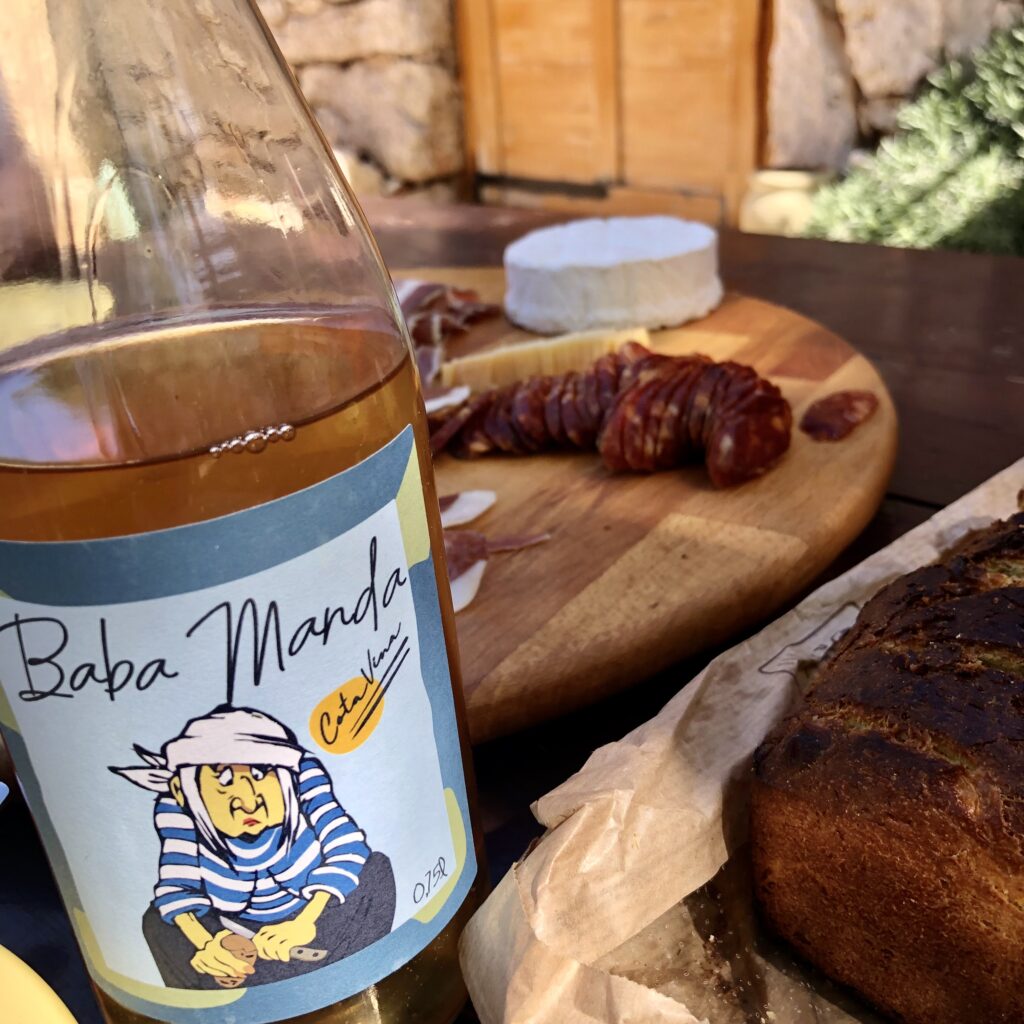
Cota Winery, in Oklaj, represents a traditional, low-intervention approach to farming the same grape varieties. The wines are especially sought after by natural wine lovers. When we visited, we met Petar Cota in his family’s small winery courtyard, where he poured samples and sliced excellent homemade breads and cheese. Cota’s bottle labels are instantly likable, and each carries a story—the same can be said of the wines inside. They are personal, handmade, and of course every vintage is slightly different.
A two-minute walk across the main road brings you to the winery courtyard of Ivica Džapo. He is a longtime grower of Debit in particular, but also has vineyard planted to Maraština, Lasina and Merlot, and sells fruit to some of Dalmatia’s top wineries. And he makes excellent wine himself, including a custom Debit (2025) for Pelegrini and a Maraština that is on the list at Nostalgija in Šibenik (see restaurants, below). His is one of the families in Oklaj that helped rebuild the wine industry—and everything else—after its complete destruction in the war of 1991-95. (Pro tip: Bring someone who can translate from Croatian, or rely on the universal language of wine.)
Route 4: Restorative Organic Hills (Jadrtovac)
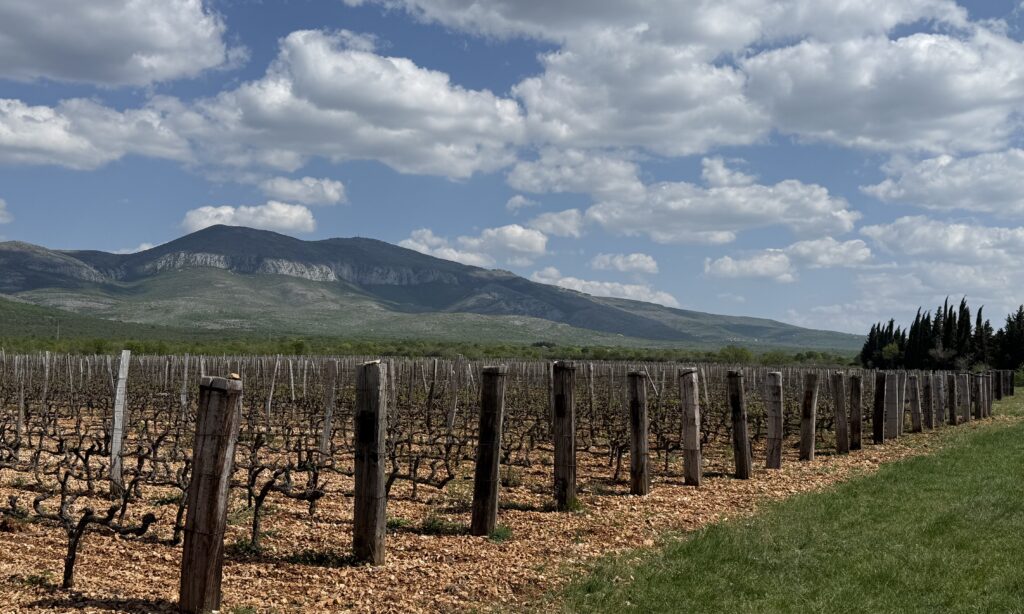
Jadrtovac is a tiny village on the shore of Morinje Bay, a 20-minute drive from Šibenik. It is also a comparatively vast, organically farmed region of vineyards over the hill from the village, where four wineries (Testament, Delusional, Dalmatian Ego, and the Hvar-based winery Zlatan Otok) grow fruit. Unlike the tiny, scattered plots in much of Dalmatia, the vineyards here are contiguous. They have been created over the past 20 years using karst reclamation, a process of grinding the stone that results in the uniform vine rows without need for terraces.
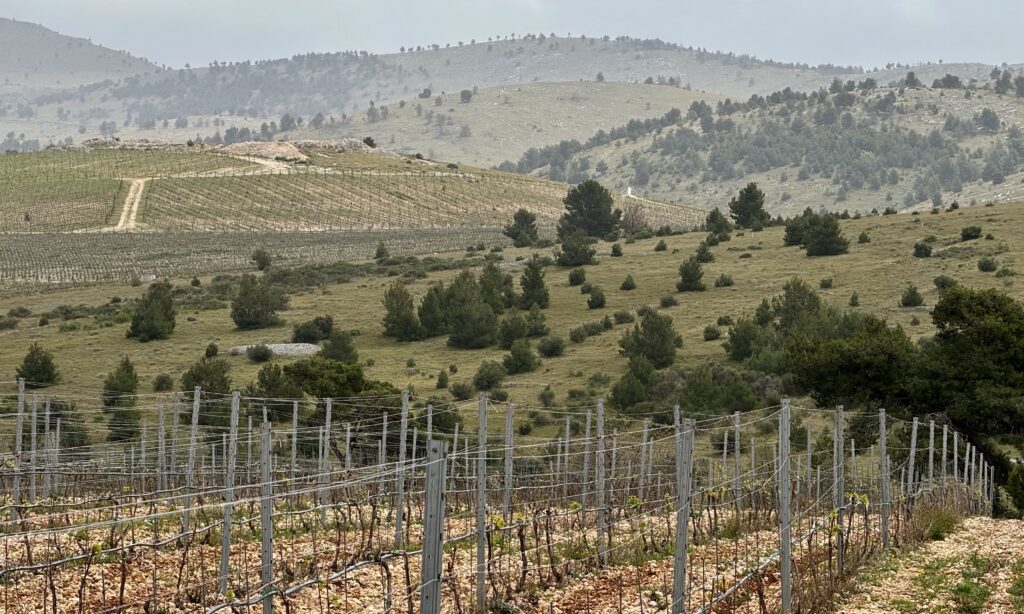
The best way to enjoy the vineyards and wild trails of Jadrtovac is to roam them on foot. You can park before the village, at the left turn to Testament Winery, and walk the easy, three-plus-hour Jadrtovac-Žaborić route through the vineyards, with a final view of Morinje Bay before you descend to sea level again. Or simply drive or cycle up the hill to the Testament tasting room and wander freely from there–incentivized by a glass or two of excellent wine. Seasonal highlights are in May, when wildflowers are at their peak, and August, when the grapes are almost ripe (but mind the heat). Near the village of Grebaštica is a shorter (one-hour) but steeper hike to see the medieval fortification wall of Oštrica.
Testament Winery is owned by Swedish investors, but run by local winemaker Juraj Sladić, the brother of Ante (see Route 2). At the tasting room, sample excellent wines from indigenous varieties including Debit, Maraština, Pošip, Babić and Tribidrag (the original Zinfandel). Order some snacks and settle in for an introduction to regional wines.
For a different type of tasting experience, there is Delusional Wine. Of course there is a good story behind the name, and owner Mike Pulley is the one to tell you. Contact him to arrange a tasting of his low-intervention wines in the hilltop vineyard, and hear what it’s like to “commute” from England to Croatia as a winery owner.
Dalmatian Ego will be building a winery of its own in the Jadrtovac vineyards. They currently have a tasting room with a lovely view on the site, open evenings in the season. Also look for their vibrant Pošip, juicy Babić and other wines on restaurant wine lists in Šibenik.
Route 5: Babić University (Primošten)
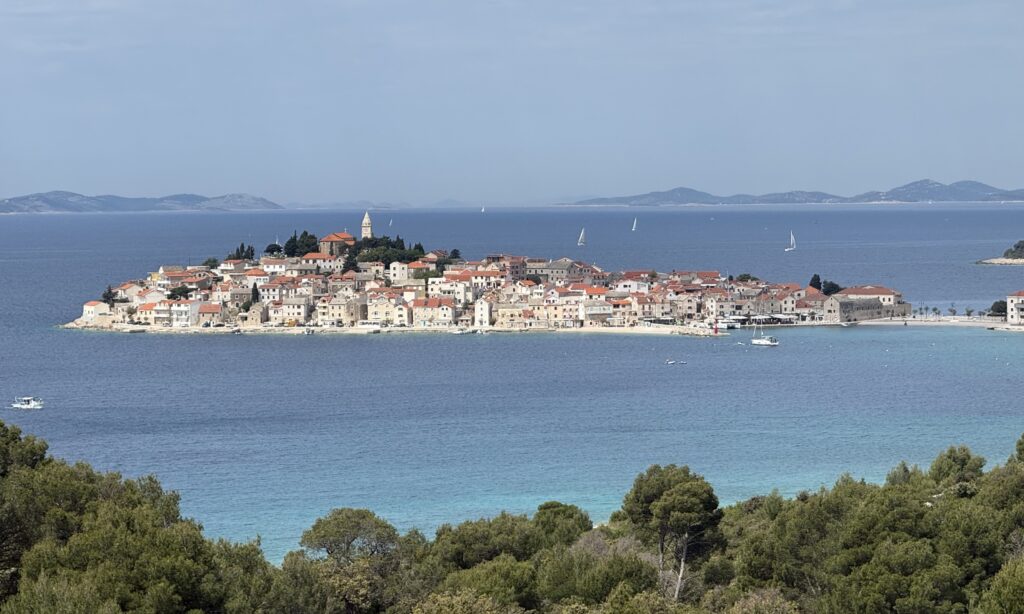
The original village of Primošten was built on a dome-shaped island very close to shore, surrounded by defensive walls and accessible via a drawbridge. And, remarkably, this is still the historic center you see today. (The drawbridge was replaced with a causeway in the mid-16th century, after the island was successfully defended against the Ottomans.) Park in the mainland part of town and stroll across the causeway and through the original gate. You can wander the narrow streets, visit beaches easily accessible from the center, or take a short drive or steep pedal to the lookout (Our Lady of Loreto) on the hilltop to the south, to gaze down on Primošten and the aquamarine sea.
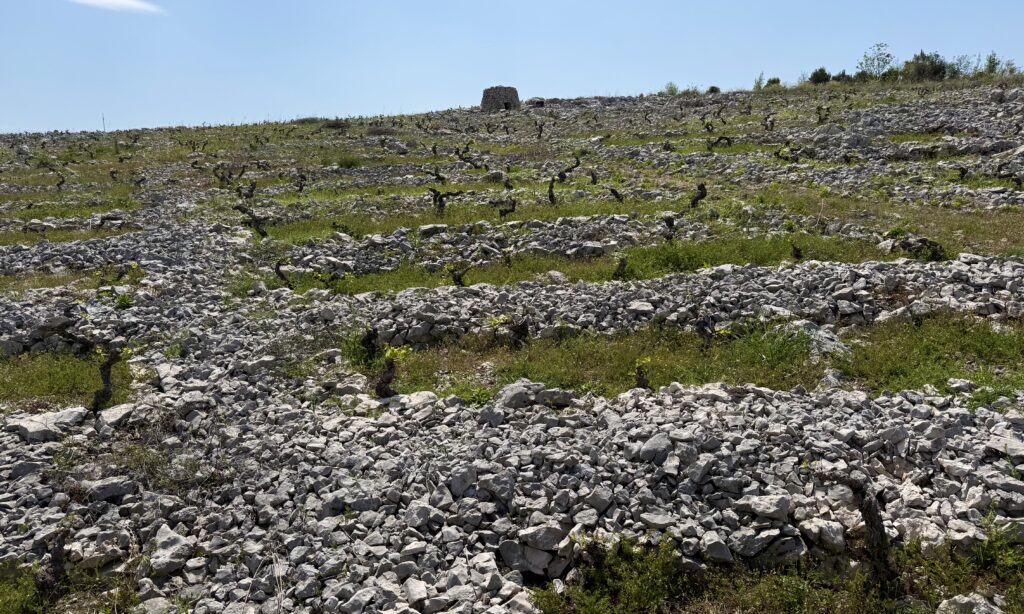
The nearby hillsides of the mainland, now crowded with summer homes, were once vineyards. This is a common story around the world. But if you drive the old roads of the mainland, you will see another reason the traditional vineyards are becoming scarce. The land here is hilly and virtually all stones. Farmers in the past moved the stones (as everywhere in Dalmatia) to make space for grazing or for vines or olive trees. But around Primošten, they used the stones not to make walls and piles but instead a gridwork of boxes in which four or six vines could be planted. The boxes take maintenance, there is no irrigation and you can’t use a tractor in these vineyards. The vines huddle on the ground, perhaps propped up with a stone or two. Pruning, picking…everything is back-breaking work. But one variety loves this parched, miserly ground. It is the red grape Babić.
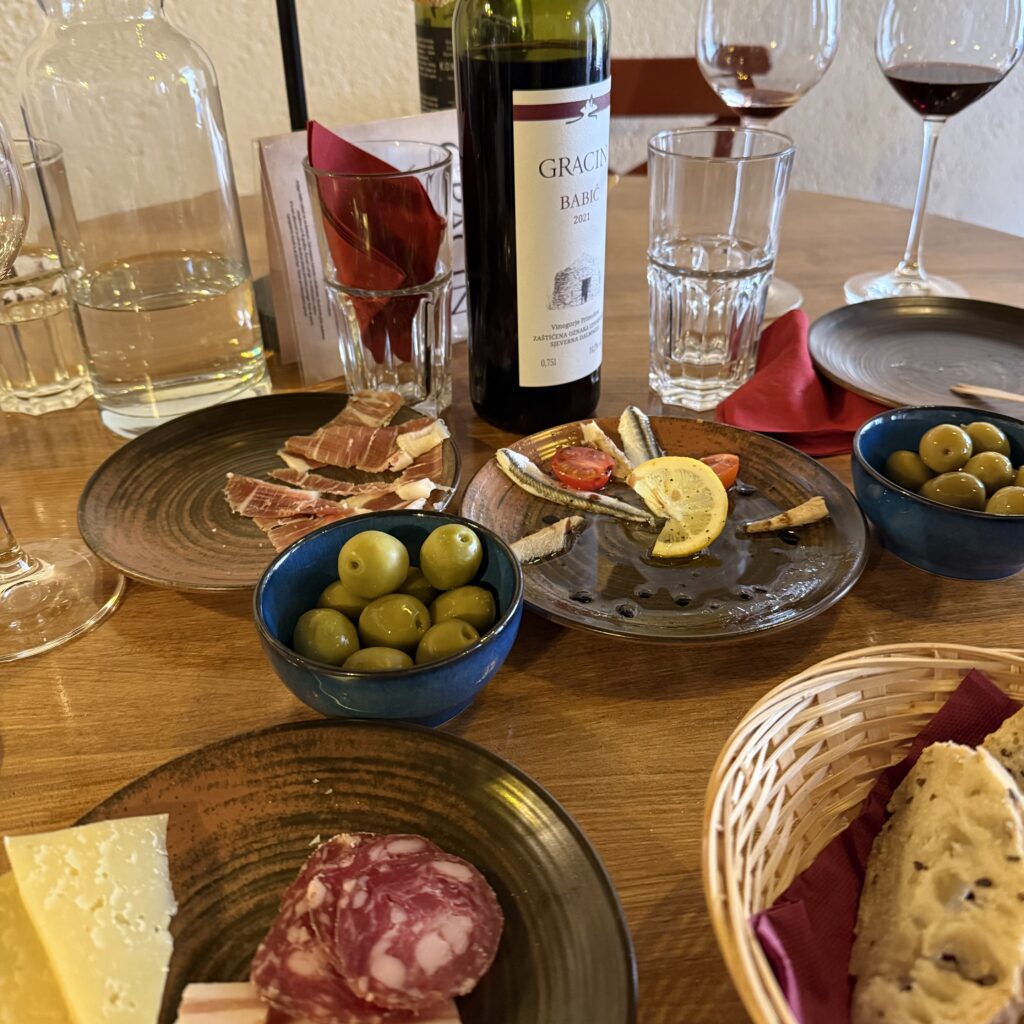
For a survey course in Babić, there are a number of tasting stops. One is right in the old town, the tasting room of Gracin Winery. Leo Gracin has taught many of Croatia’s best young winemakers over the years, at the enology schools in Split and in Zagreb. His Babić is a classic, earthy, not-too-brawny wine that ages beautifully.
Across town–that is, a two-minute walk–is the wine bar Peškafondo, owned by Marko Pavlak. Pavlak carries a cross-section of wines from the Primošten area, particularly Babić. He is also an authority on the natural wines of the region, and is happy to explain why natural (low-intervention) wine is important.
Venturing out around the countryside, make a first stop at Vinas Mora, in a repurposed bakery overlooking Primošten. Here you can taste a lineup of Babić wines sourced from vineyards that represent regional and what can be thought of as premier and grand cru quality levels. Don’t miss their Maraština and a remarkably light Plavac Mali. Most fans of the winery consider these natural wines. Co-owner Krešo Petreković prefers to change the emphasis: “We make good wines.”
Further into the countryside is Prgin Winery, in a former schoolhouse. This boutique winery does a good job of offering visitors what they want: a great story, genuine hospitality and expressive, enjoyable wines in a pretty area of cafe seating in front of the winery. They host a popular series of wine-and-music events in the summer–follow their Instagram.
A visit to Prgin would make an easy bike trip from Primošten. Somewhat longer (27km) but highly recommended would be a visit to Galjin Dvor and Matošin Winery, with a loop along the gravel roads between, to see the countryside. Galjin Dvor, in the village of Kruševo, is an impeccably restored dvor–a series of small stone buildings forming a family compound around a central courtyard. This is the old family home of Rade Županović, who works in television but has spent his free time transforming these buildings, one by one. They now include his family’s living spaces, a kitchen as well as rooms where groups of different sizes can taste wine, and even enjoy a traditional meal arranged in advance.
If you want the backroads loop, continue east on the road past Galjin Dvor. Very soon, at the fork with the little shrine, stay left, then immediately turn into the narrow country road on the left. Now you can wind your way, staying on the main branch of this mostly gravel road, past olive groves and vineyards, towards Matošin Winery. After about 5km, when you are almost there, you will see one of the iconic boxed vineyards on the left. Then turn right at the sign to visit Ivo Matošin at his dramatic vineyard-with-a-view. Matošin’s wines, exclusively from Babić, are also examples of natural wine. (Pro tip: If you want paved roads instead of gravel, navigate to Matošin via Široke village.)
Restaurants for Wine Lovers
Two restaurants in Šibenik stood out on our last visit for their dedication to featuring wine on an equal footing with food. Each offers a thoughtful wine list and wines sourced specially for the restaurant, but one will appeal to destination food lovers with the budget for Michelin stars, and the other to travelers who want a “discovery” at very reasonable prices.
The first is Pelegrini, the focus of many a food pilgrimage and the holder of a Michelin star since 2018. Chef Rudolf Štefan consistently presents jewellike—and eminently edible—dishes from the best of local ingredients. Sommelier Branimir Vukšić has assembled a stellar collection of wines by the bottle; the wine pairings by the glass are exclusive to the restaurant and tend to fall on the natural wine spectrum. The service, the setting, the swifts swooping among the Renaissance stone walls…all combine to make Pelegrini a world-class destination.
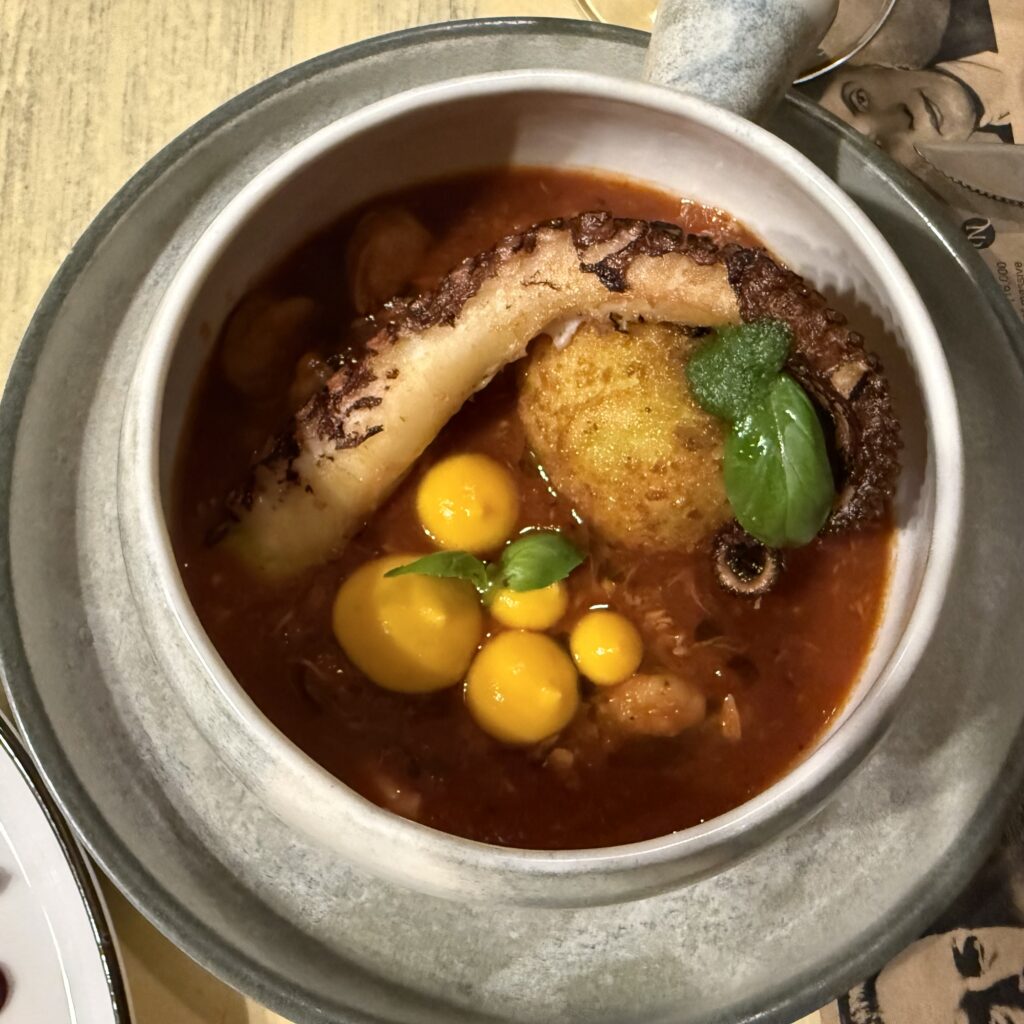
Two years ago, Konoba Nostalgija was reborn under a father-and-son team from Zagreb who relocated to Šibenik after Covid. At the edge of a broad pedestrian approach to the old city, they have created an inviting outdoor pergola and a small, cozy nook inside. In this casual setting they present exciting food with intensely local flavors. The perfect orbs of chicken liver mousse look so much like chocolate truffles you’d swear you tasted cocoa. A riff on the traditional seafood stew, brudet, contains an octopus tendril and mussels artfully arranged around a semolina super-gnocchi in a smoky tomato broth. Dessert is a layered bar of cookie, fig paste and white chocolate with a boozy sous-vide fig standing by.
With personal, proven wine pairings from the well-curated list, Nostalgija offers a dining experience far beyond the standard tourist fare.
[Title photo: Šibenik from St. Michael’s fort; photo: Staff/CCM]
Post updated 10 July to reflect the opening of Dalmatian Ego tasting room.